
Table of Contents
- Understanding Atmospheric Rivers – The Science Behind the Storm
- Why Your Home Is Vulnerable – Pacific Northwest-Specific Risks
- The Eight Critical Protection Points – Technical Mitigation Strategies
- The Hidden Financial Risks – Insurance Gaps and Cost Analysis
- When Prevention Fails – Recognizing Damage and Responding Quickly
- Final Thoughts
- References
The Pacific Northwest is famous for its gentle drizzle and evergreen landscapes, but the real threat to your home doesn’t come from constant light rain—it comes from Atmospheric Rivers (ARs). These powerful “rivers in the sky” can unleash rainfall equivalent to 7.5 to 15 times the flow of the Mississippi River in just a matter of days. For homeowners in Monroe, Snohomish County, and North King County, these weather systems represent the single greatest risk to residential infrastructure.
While you may be familiar with the term “Pineapple Express,” what you might not know is that climate models project the most extreme AR events could increase by up to 290% by the end of the century. With ARs already causing $1.1 billion in annual flood damages across the western U.S., and accounting for over 90% of extreme precipitation events in Washington that trigger insurance claims, understanding and preparing for these storms isn’t optional—it’s essential.
This comprehensive guide goes beyond generic weather warnings. We’ll explore the meteorological science behind ARs, decode the specific vulnerabilities of Pacific Northwest homes, provide technical mitigation strategies, and reveal the hidden insurance gaps that could leave you financially exposed. Whether you’re a longtime resident or new to the region, this is your blueprint for protecting what matters most.
“Atmospheric rivers aren’t just big storms— they’re the single greatest weather-related threat to many Pacific Northwest homes.”
Understanding Atmospheric Rivers – The Science Behind the Storm
What Are Atmospheric Rivers and Why Should Pacific Northwest Homeowners Care?
Atmospheric rivers are narrow corridors of concentrated water vapor in the atmosphere that transport moisture from tropical regions to mid-latitudes. Think of them as rivers flowing through the sky rather than across land. A strong AR can carry water vapor equivalent to 7.5 to 15 times the Mississippi River’s average flow—an almost incomprehensible amount of moisture moving through the atmosphere at any given moment.
The “Pineapple Express” Phenomenon
The most destructive ARs originate near Hawaii, transporting warm subtropical moisture directly to the Pacific Northwest. These systems are particularly dangerous because they’re warm—snow levels rise dramatically, causing rain to fall on existing mountain snowpack rather than adding to it. This “rain-on-snow” effect can increase river flows by 20% to 50% compared to rain alone, triggering rapid valley flooding that catches communities off guard.
When this warm, moisture-laden air encounters the Cascade and Olympic mountain ranges, orographic enhancement occurs. The mountains force the air upward, cooling it rapidly and condensing massive amounts of precipitation. This is why western-facing slopes receive the heaviest rainfall and why valleys below—including Monroe, Snohomish County, and North King County—experience such dramatic flooding events.
The AR Intensity Scale
The Center for Western Weather and Water Extremes (CW3E) categorizes ARs on a 1–5 scale based on Integrated Water Vapor Transport (IVT) duration and intensity:
- AR Cat 1–2: Primarily beneficial for water supply, replenishing reservoirs with manageable rainfall.
- AR Cat 3: Balance of benefit and hazard—good for water resources but requires monitoring.
- AR Cat 4–5: Primarily hazardous, causing significant flooding and infrastructure damage.
Understanding this scale helps homeowners assess the threat level when forecasters issue warnings. A Cat 3 AR requires vigilance; a Cat 4 or 5 demands immediate action to protect your property.
Actionable Tip: Watch the AR Category, Not Just the Rain Icon
- When a storm is forecast, check if it’s classified as an AR and what category it is.
- Treat AR Cat 3 as a “prepare now” warning and AR Cat 4–5 as “take immediate protective action.”
- Sign up for local river and flood alerts in Snohomish County and your specific city.
Climate Change Amplification
University of Washington research reveals a concerning trend: while annual precipitation may increase only slightly in the Pacific Northwest, the character of rainfall is changing dramatically. The heaviest rain events are projected to become 22% more intense by the 2080s due to warmer air holding more moisture (a relationship described by the Clausius-Clapeyron equation: approximately 7% more moisture per 1°C of warming).
This means the infrastructure, drainage systems, and home construction standards that protected previous generations may prove inadequate for the climate you’ll experience over the next several decades. Preparation isn’t about the weather patterns of the past—it’s about the intensifying storms of the future.
Why Your Home Is Vulnerable – Pacific Northwest-Specific Risks
The Perfect Storm: How PNW Geography, Soil, and Construction Create Unique Vulnerabilities
Your home faces threats that homeowners in other regions simply don’t encounter. The combination of local geography, soil composition, and traditional construction practices creates a vulnerability profile unique to the Pacific Northwest.
The Clay Bowl Effect
Snohomish County soil composition is predominantly glacial till or heavy clay—legacy deposits from Ice Age glaciers that once covered the region. These soils have extremely poor percolation rates and expand when saturated, creating what building scientists call a “bowl” effect. Water trapped in saturated clay soil exerts tremendous hydrostatic pressure against your foundation—approximately 62.4 pounds per cubic foot of saturated soil pushing relentlessly against basement walls and seeking entry through any microscopic crack or cold joint.
Unlike sandy or loamy soils that drain quickly, clay essentially becomes a water-holding vessel during AR events. If your home’s grading isn’t perfect—and most older homes’ grading has settled over time—water pools against the foundation rather than flowing away from it.
River System Vulnerabilities
The Snohomish, Skykomish, and Snoqualmie river systems are prone to rapid cresting during AR events. These aren’t slow-rising floods that give you days of warning. When an AR stalls over the Cascades, these rivers can rise several feet in mere hours.
The November 2021 AR sequence demonstrated this dramatically. In nearby Sumas and Everson, 85% of homes suffered water damage—and critically, many were outside designated high-risk flood zones. FEMA flood maps, while useful, don’t fully account for the unique hydrology of AR-driven flooding combined with saturated clay soils.
Vegetation and Debris Characteristics
Pacific Northwest vegetation creates specific maintenance challenges. Douglas Fir needles and Bigleaf Maple leaves don’t just clog gutters—they create dense, mat-like debris that, when wet, forms what we call “gutter dams.” These biological barriers cause water to spill over fascia boards rather than flowing through downspouts, leading to wood rot, soffit damage, and foundation infiltration.
A single Douglas Fir can drop tens of thousands of needles during fall, and when these accumulate in gutters with moss and leaf debris, they create a nearly waterproof barrier that defeats even well-designed gutter systems.
Crawl Space Design Failures
Many Pacific Northwest homes feature vented crawl spaces—a design that was standard practice decades ago but is now understood to be problematic, particularly during AR events. These vents were originally intended to “air out” moisture, but building science has proven they actually introduce more moisture problems than they solve.
During ARs, rising groundwater can transform these spaces into standing ponds, creating ideal conditions for mold growth and structural wood rot. The high ambient humidity of the Pacific Northwest (typically 60–80% year-round) means these spaces never truly dry out between storm events.
The “Outside the Flood Zone” Myth
One of the most dangerous misconceptions Pacific Northwest homeowners hold is that FEMA flood zone designations tell the complete story. These maps designate certain areas as low-risk based on historical river flooding patterns, but they don’t adequately account for surface water runoff on saturated clay soils during AR events.
The 2021 AR events shattered this assumption. Homes that had never flooded in living memory—homes well outside the 100-year floodplain—suddenly found themselves with several feet of water in basements and crawl spaces. The water didn’t come from rivers overflowing their banks; it came from overwhelmed drainage systems and saturated soils that had nowhere else to send the water but into homes.
Infrastructure Cascade Failures
Just as the 2017 Oroville Dam spillway failed when an AR series exceeded its design parameters, home drainage systems that function adequately under normal rainfall can fail catastrophically during Cat 4 or Cat 5 AR events. Your home’s drainage capacity is only as good as its worst-case performance—not its average-case performance.
Actionable Tip: Map Your Property’s Weak Points Before the Next Storm
- Walk your property during a heavy rain and note where water pools or flows toward the house.
- Check low windows, stairwells, and crawl space vents for active water paths.
- Use photos and notes to plan targeted improvements (grading, drains, rain gardens).
The Eight Critical Protection Points – Technical Mitigation Strategies
Engineer Your Defense: Eight Science-Backed Strategies to Protect Your Home from Atmospheric Rivers
Generic weather preparedness advice won’t cut it for Pacific Northwest homeowners facing AR threats. These eight technically detailed strategies are specifically designed for the unique challenges of Monroe, Snohomish County, and North King County.
-
Roof and Gutter Hydraulics
Let’s start with the math: A standard 1,000 square foot roof sheds approximately 600 gallons of water per inch of rainfall. During a Cat 4 AR dropping 5+ inches over 24–48 hours, your home must successfully divert 3,000+ gallons of water away from the foundation. If your gutters are clogged with Douglas Fir needles and maple leaves, this water cascades over the edges, saturating the soil directly adjacent to your foundation—exactly where you don’t want it.
Action items:
- Clean gutters twice annually at minimum: once in late spring after the fir pollen season, and again in late fall after leaf drop.
- Install gutter guards specifically designed for needle-leaf debris (standard mesh guards often fail with fine fir needles).
- Inspect for proper pitch: gutters need a minimum ¼ inch slope per 10 feet of run to drain effectively.
“`
-
Downspout Engineering
Here’s where most homeowners make a critical error: they assume downspouts that terminate at ground level are sufficient. In clay soils, they absolutely are not. Water needs to be conveyed 5 to 10 feet from the foundation—far enough that even saturated clay soil can’t create a hydraulic connection back to your basement or crawl space.
Pacific Northwest-specific upgrade: Splash blocks are a start, but they’re often inadequate in clay soils. Install piped catch basin drains that direct water to daylight (a natural grade away from the home) or into a properly designed rain garden. The investment of $200–500 in proper downspout drainage can prevent $5,000–15,000 in foundation water damage.
-
Grading and Slope Compliance
The International Residential Code (IRC) requires a 5% slope—that’s 6 inches of fall over 10 feet—away from the foundation. This isn’t a suggestion; it’s a building code requirement for good reason. Over time, soil settles, landscaping changes grade, and what was once proper drainage becomes a depression that collects water.
Assessment method: Use a 10-foot straight edge and a level to verify slope around your entire foundation perimeter. Pay special attention to areas where patios, walkways, or landscaping beds have been added over the years. Correct negative grading with soil amendments, ensuring water flows away from the structure at all points.
-
Sump Pump Redundancy
Sump pumps face a cruel irony: they’re most likely to fail precisely when you need them most. Statistics show pump failures peak during AR events due to power outages caused by wind, falling trees, and overloaded electrical infrastructure. A primary pump without backup protection is a single point of failure in your home’s defense system.
Solution: Install a battery backup sump pump (typically $300–600) or a water-powered backup system that operates off municipal water pressure. Test your system quarterly by simulating power loss—most homeowners discover their backup system doesn’t work only when they truly need it.
-
Crawl Space Encapsulation
Research by Building Science Corporation has definitively demonstrated that “closed” crawl spaces with vapor barriers and dehumidification systems dramatically outperform traditional vented designs, particularly in humid climates like the Pacific Northwest. Encapsulation prevents the ground moisture migration that creates ideal conditions for mold growth and wood rot.
Return on investment: While encapsulation represents a significant investment ($3,000–8,000 depending on crawl space size), it prevents mold growth, improves energy efficiency (reducing heating/cooling costs), and adds long-term structural protection. For homes in AR-vulnerable areas, it’s one of the highest-value improvements you can make.
-
Rain Garden Installation
Rain gardens aren’t just attractive landscaping—they’re passive engineering solutions that reduce foundation water load. Native plant rain gardens featuring species like Sword Fern, Red Osier Dogwood, and Western Bleeding Heart can absorb 30% more water than standard lawns, reducing both the burden on municipal storm systems and the saturation of soil around your foundation.
Placement strategy: Position rain gardens 10+ feet from the foundation in the natural drainage path where downspout extensions terminate. The depression should be 6–8 inches deep and filled with amended soil that promotes infiltration. During AR events, these gardens can absorb hundreds of gallons of water that would otherwise contribute to foundation pressure.
-
Sewer Backflow Prevention
When AR precipitation overwhelms municipal sewer systems, the results can be catastrophic. Sewage can backflow into homes through floor drains, toilets, and other plumbing fixtures—creating not just water damage but a biohazard situation requiring specialized remediation.
Critical protection: Install a mainline check valve ($1,500–3,000 professionally installed). This one-way valve prevents reverse flow while allowing normal drainage. It’s expensive, but consider that sewage backflow remediation can easily exceed $20,000 due to the specialized cleaning, disinfection, and material removal required.
-
Window Well Covers and Sealing
Basement windows and their associated window wells act as collection basins during heavy rainfall. Without proper covers, these wells fill with water that then seeks entry through window seals or overwhelms window well drainage systems.
Protection measures: Install clear polycarbonate window well covers that shed water while allowing natural light. Verify that basement window seals are intact and that window well drains (if present) aren’t clogged with debris. This relatively inexpensive measure ($50–100 per window well) prevents a common entry point for AR-driven water intrusion.
“`
The Hidden Financial Risks – Insurance Gaps and Cost Analysis
What Your Insurance Won’t Tell You: Understanding Coverage Gaps and the True Cost of Inaction
Insurance policies are complex documents filled with technical language, exclusions, and limitations that most homeowners don’t fully understand until they file a claim. When it comes to AR-related damage, ignorance of these gaps can prove financially devastating.
The “Falling vs. Rising Water” Distinction
This is perhaps the most critical insurance concept Pacific Northwest homeowners need to understand:
Homeowners insurance typically covers “falling water” damage—rain entering through a wind-damaged roof, water infiltrating through a failed window, or similar scenarios where precipitation enters the home from above.
What’s NOT covered: “Rising water” from river overflow, groundwater seepage, or surface water runoff requires separate FEMA National Flood Insurance Program (NFIP) policies. Many Monroe and Snohomish County homeowners believe they’re covered because they have homeowners insurance, but they have no flood insurance because their home is “outside the flood zone.”
The November 2021 AR events exposed this gap painfully. Thousands of homeowners discovered their insurance would pay nothing for basements filled with groundwater seepage or surface runoff—events their policies specifically excluded.
The Sewage Backup Rider
Standard homeowners policies include another critical exclusion: damage from sewer or drain backups. When AR precipitation overwhelms municipal sewer systems and sewage backs up into your home, your standard policy will likely deny the claim.
The solution: Sewage backup coverage requires a separate endorsement or rider, typically costing $50–100 annually. Without this rider, a sewage backflow event during an AR—which could cost $20,000+ to remediate due to biohazard protocols—is entirely out-of-pocket.
Cost-Benefit Analysis – Proactive vs. Reactive
The National Institute of Building Sciences established that hazard mitigation saves society $6 for every $1 spent. For individual homeowners, the return on investment for AR preparedness is even more compelling:
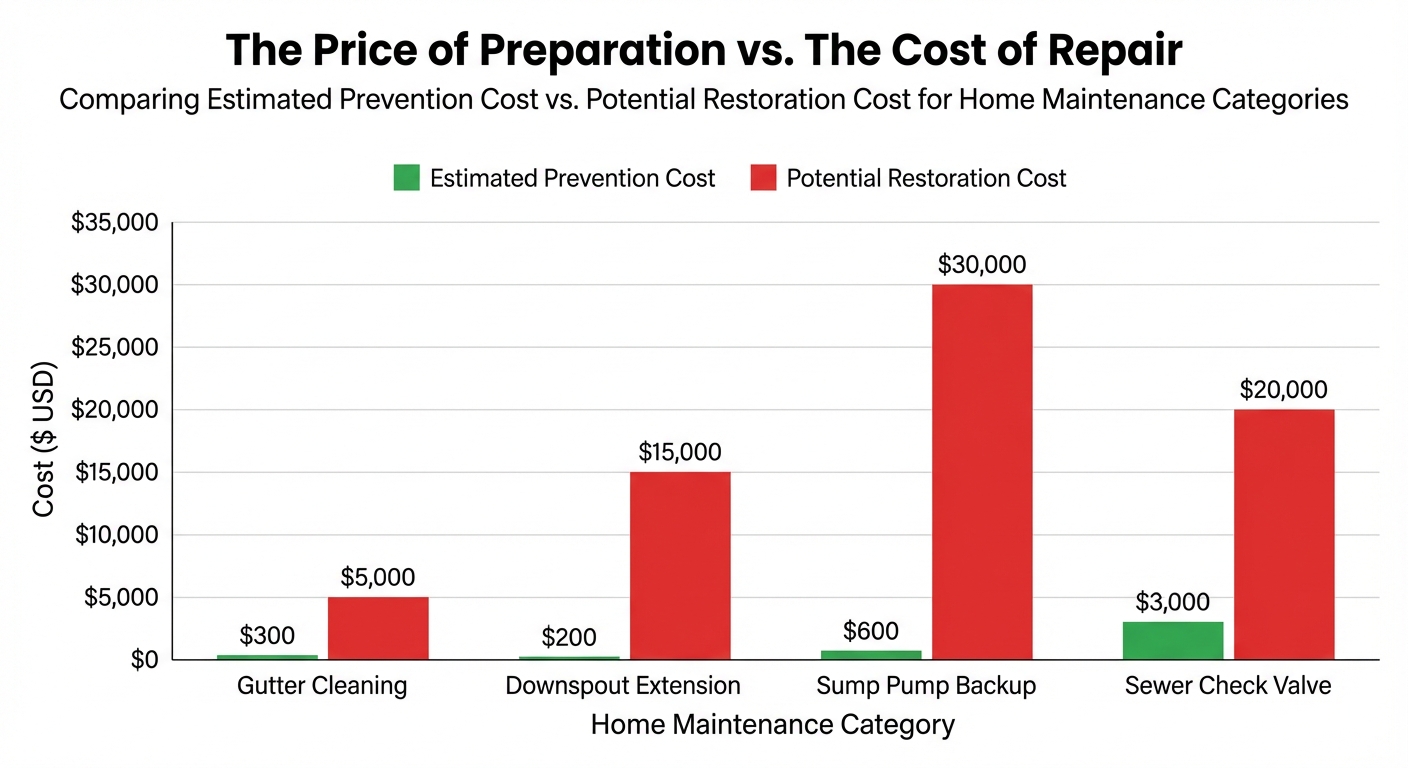
The chart above illustrates the dramatic cost difference between proactive maintenance and reactive restoration. Consider these specific scenarios:
| Mitigation Measure | Typical Upfront Cost | Likely Damage Without It | Approximate ROI |
|---|---|---|---|
| Gutter cleaning (twice annually) | $0–$300 | Fascia rot, siding damage, basement leaks ($2,000–$5,000) | ~7x–17x return |
| Downspout extensions / piped drains | $50–$200 | Foundation leaks and structural damage ($5,000–$15,000) | ~25x–300x return |
| Sump pump battery backup | $300–$600 | Flooded basement ($10,000–$30,000+) | ~17x–100x return |
| Sewer mainline check valve | $1,500–$3,000 | Sewage backflow & biohazard cleanup ($20,000+) | ~7x–13x return |
| Annual flood insurance | ≈$700/year | Catastrophic uninsured loss (tens to hundreds of thousands) | Potentially life-changing protection |
The pattern is clear: every dollar spent on preparation delivers multiple dollars in avoided repair costs, not to mention the avoided stress, displacement, and disruption that major water damage events cause.
Actionable Tip: Review Your Policy with AR Scenarios in Mind
- Ask your agent to explain, in plain language, what happens if groundwater seeps into your basement.
- Confirm whether you have a sewer backup rider and what its coverage limit is.
- Get a written quote for NFIP flood insurance—even if you’re “outside the flood zone.”
When Prevention Fails – Recognizing Damage and Responding Quickly
The Critical First 48 Hours: How to Recognize AR Damage and Why Immediate Action Prevents Catastrophic Loss
Even with perfect preparation, AR events can overwhelm home defenses. When this happens, your response in the first 24–48 hours determines whether you face a manageable cleanup or a catastrophic loss.
The Mold Timeline
This cannot be overstated: mold can begin colonizing damp surfaces—drywall, wood, insulation—within 24 to 48 hours of water exposure. In the Pacific Northwest’s high ambient humidity environment (60–80% relative humidity year-round), natural drying is nearly impossible without professional dehumidification equipment.
The hidden danger is that mold often establishes within wall cavities and crawl spaces before becoming visible. By the time you see surface growth, extensive colonization may have already occurred behind walls and in structural spaces. This is why professional assessment using thermal imaging and moisture meters is critical after any significant water intrusion event.
Warning Signs After an AR Event
Exterior indicators:
- Water staining on foundation walls, particularly near the base or around windows.
- Saturated soil adjacent to the foundation, standing water in window wells.
- Gutter overflow marks streaking down siding.
- Separated or detached downspouts, visible erosion channels in landscaping.
- Debris accumulation against the home’s perimeter.
Interior red flags:
- Musty odors (often the first indicator of microbial growth, even before visible mold).
- Discoloration on baseboards or lower sections of drywall.
- Buckled hardwood flooring or bubbling vinyl flooring.
- Increased interior humidity levels (above 60% relative humidity).
- Efflorescence—white, chalky deposits on concrete surfaces indicating water movement through the material.
Immediate Action Steps
1. Document everything: Before beginning any cleanup, photograph and video all damage for insurance claims. Insurance adjusters need to see the extent of damage as it occurred, not after you’ve already started repairs. This documentation is your financial protection.
2. Stop additional water intrusion: If the AR event is ongoing or if damage has compromised your home’s weather envelope, deploy temporary measures like tarps or sandbags to prevent additional water entry.
3. Call professionals immediately: Water damage restoration is intensely time-sensitive. Robinson Restoration’s 24/7 emergency response ensures mitigation begins within hours, not days—which can make the difference between a manageable restoration and total loss of materials and contents.
4. Don’t wait for insurance approval to begin emergency mitigation: Secondary damage from mold, structural deterioration, and microbial growth accelerates rapidly. Insurance policies typically require homeowners to mitigate damage to prevent further loss. Begin emergency water extraction and drying immediately; documentation will support your claim regardless of timing.
When to Call Robinson Restoration
Contact professional water damage restoration services for:
- Any water intrusion event that exceeds what can be dried with household fans within 24 hours.
- Suspected mold growth or persistent musty odors that don’t resolve with ventilation.
- Sewage backup or contaminated water exposure (this requires biohazard protocols).
- Uncertainty about damage extent (Robinson Restoration offers free inspection and moisture assessment).
- Insurance claim assistance (professional documentation strengthens claims and ensures proper scope of work).
The Pacific Northwest’s unique combination of AR frequency, clay soils, and high humidity means that minor water intrusion events can escalate into major problems faster than in other climates. When in doubt, professional assessment provides peace of mind and often identifies hidden damage that would worsen over time if left unaddressed.
Final Thoughts
Atmospheric Rivers are not going away—climate science tells us they’re intensifying. For Pacific Northwest homeowners, particularly in Monroe, Snohomish County, and North King County, the question isn’t if your home will face an AR event, but when.
The good news? You have agency. The eight mitigation strategies outlined in this guide represent proven, engineering-backed defenses that dramatically reduce your risk. Whether it’s extending your downspouts, upgrading your sump pump, or finally installing that sewer check valve, each action compounds your protection. And with hazard mitigation delivering $6 in savings for every $1 invested, these aren’t expenses—they’re investments in your home’s resilience.
But if the worst does happen—if an atmospheric river overwhelms your defenses or you discover damage from a previous event—remember that the first 48 hours are critical. Mold doesn’t wait, and neither should you.
Ready to Protect Your Home from the Next Atmospheric River?
Robinson Restoration is your local partner in both preparation and recovery—from free property assessments to 24/7 emergency water damage response.
Schedule Your Free Preparedness ConsultationExplore service areas and contact options on the Robinson Restoration locations page.
From Snohomish County river valleys to North King County neighborhoods, proactive planning today can mean the difference between a close call and a life-altering loss when the next AR arrives.
References:
- NOAA. (2023). What is an atmospheric river? https://www.noaa.gov/stories/what-are-atmospheric-rivers
- NASA Earth Observatory. (2017). Atmospheric Rivers: A Primary Driver of Flood Damages. https://earthobservatory.nasa.gov/images/91350/atmospheric-rivers-a-primary-driver-of-flood-damages
- Center for Western Weather and Water Extremes (CW3E). (2024). Atmospheric River Scale. https://cw3e.ucsd.edu/ar-scale/
- University of Washington Climate Impacts Group. (2020). No Time to Waste: The IPCC Special Report on Global Warming. https://cig.uw.edu/resources/special-reports/no-time-to-waste/
- Mass, C., et al. (2011). Extreme Precipitation over the Western United States. Journal of Hydrometeorology. https://journals.ametsoc.org/view/journals/hydr/12/5/2011jhm1358_1.xml
- Corringham, T. W., et al. (2019). Atmospheric rivers drive flood damages in the western United States. Science Advances. https://www.science.org/doi/10.1126/sciadv.aax4631
- FEMA. (2023). Protect Your Property from Flooding. https://www.fema.gov/sites/default/files/2020-11/fema_protect-your-property_stormwater-management.pdf
- American Society of Home Inspectors (ASHI). (2023). Wet Basements and Crawlspaces. https://www.homeinspector.org/Resources/Homeowner-Resources/Wet-Basements-and-Crawlspaces
- U.S. Department of Housing and Urban Development (HUD). (2024). Drainage and Grading. https://www.hud.gov/sites/documents/49051c2.doc
- Building Science Corporation. (2023). Crawlspaces – Either In or Out. https://www.buildingscience.com/documents/insights/bsi-009-new-light-in-crawlspaces
- Washington State University Extension. (2022). Rain Gardens: Managing Stormwater at Home. https://extension.wsu.edu/raingarden/
- FEMA. (2024). The National Flood Insurance Program. https://www.fema.gov/flood-insurance
- EPA. (2023). Mold Course Chapter 1: Introduction to Molds. https://www.epa.gov/mold/mold-course-chapter-1
- National Institute of Building Sciences (NIBS). (2019). Natural Hazard Mitigation Saves: 2019 Report. https://www.nibs.org/projects/natural-hazard-mitigation-saves-2019-report
- Washington State Department of Ecology. (2022). Focus on: Floods and Floodplain Management. https://ecology.wa.gov/Water-Shorelines/Shoreline-coastal-management/Hazards/Floods-floodplain-management